

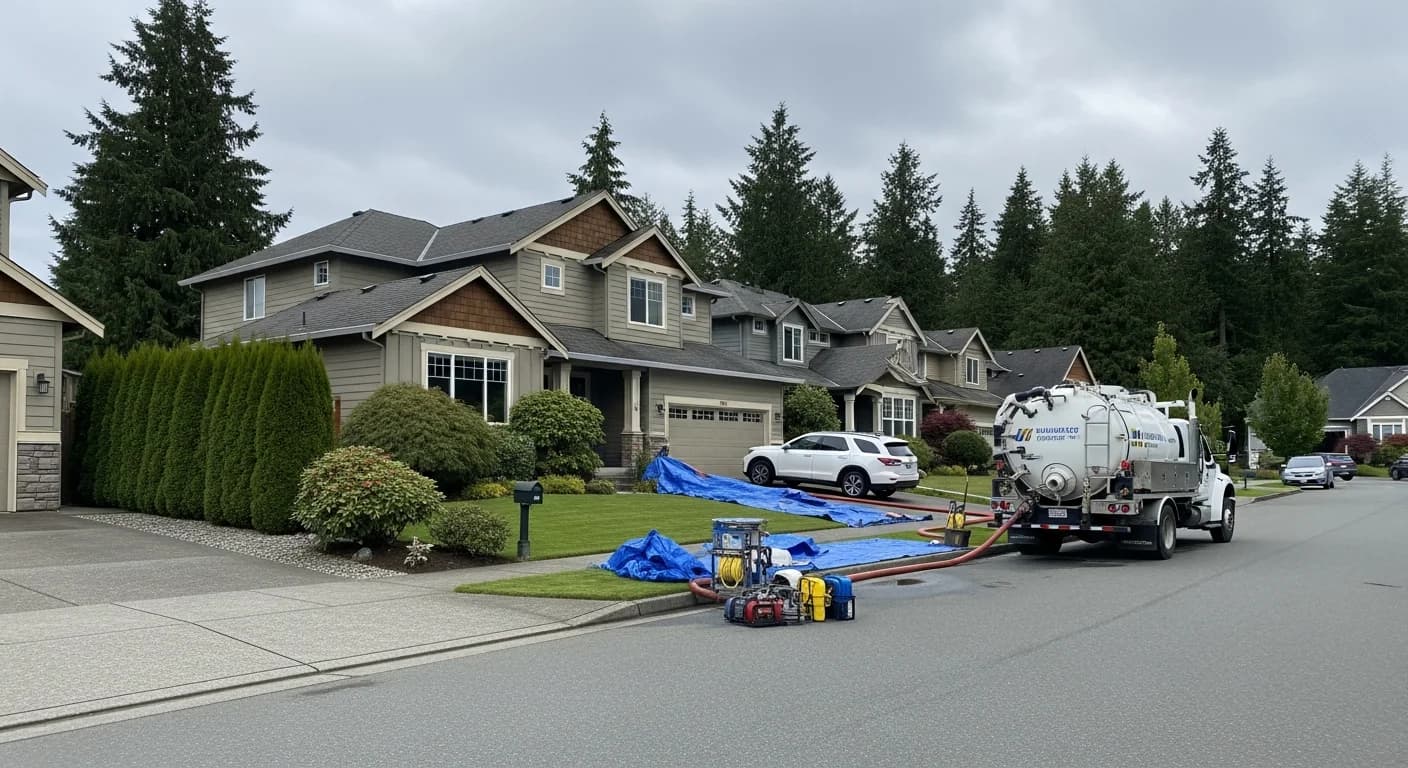
Structural Drying · Arlington, WA
Structural Drying in Arlington, WA — Dry Wood, Not Just Dry Floors
The carpet feels dry and the puddle is gone, but water can still sit in the framing and subfloor for weeks. That hidden moisture is what warps floors and feeds mold later. TDC Clean & Dry dries Arlington homes down to the structure from our Stanwood base, and we prove it with readings.
Local conditions
Why Arlington homes do not dry on their own.
Water that soaks into wood behaves differently from water on a floor. It moves into framing, subflooring, insulation and the bottom of wall cavities. From there it dries slowly, and in Arlington it often does not dry at all without help.
The reason is the air. Arlington's NOAA station records about 49 inches of precipitation a year and measurable rain on roughly 119 days. For much of the year, outdoor air is too damp to pull moisture out of a house through open windows.
The housing stock adds to the challenge. Half of Arlington's homes were built in 1996 or later, and many of those use engineered subfloors and sheathing. Those panels hold water for a long time once they get soaked, and they swell if they stay wet.
Flooding pushes water deepest of all. When the Stillaguamish crested at 21.34 feet in December 2023, valley homes took water into crawl spaces and lower walls. That kind of soaking reaches places a fan pointed at the carpet never will.
Structural drying solves this with controlled equipment and measurement. Dehumidifiers pull water out of the air, and air movers push dry air across wet surfaces. Meters then show when the wood is truly back to normal. Nothing gets closed up until the numbers say it is dry.
The local data
Why drying takes equipment in Arlington.
Arlington's climate works against natural drying for most of the year. These four figures show why a wet structure needs more than time and an open window.
- Days a year Arlington records at least a tenth of an inch of rain1
- 119 days
- Indoor humidity EPA recommends to stop mold from growing2
- Under 60%
- Median year Arlington homes were built, the era of engineered subfloors3
- 1996
- Stillaguamish crest at Arlington in December 2023, against a 14 ft flood stage4
- 21.34 ft
EPA advises drying water-damaged materials within 24 to 48 hours to prevent mold.2 In Arlington's damp months, that window is hard to hit without dehumidifiers. Daily readings show whether the structure is getting there or needs more equipment. Those numbers, not the calendar, decide when drying ends.
Highest: Nov at 7.15 in. Lowest: Jul at 1.15 in.
View data table
| Month | in |
|---|---|
| Jan | 5.92 |
| Feb | 4.42 |
| Mar | 5 |
| Apr | 4.34 |
| May | 3.43 |
| Jun | 2.66 |
| Jul | 1.15 |
| Aug | 1.34 |
| Sep | 2.49 |
| Oct | 4.94 |
| Nov | 7.15 |
| Dec | 6.15 |
Sources
- 1. NOAA NCEI, U.S. Climate Normals, Arlington, WA (station USC00450257) (1991–2020 normals)
- 2. U.S. EPA, A Brief Guide to Mold, Moisture and Your Home (current guidance)
- 3. U.S. Census Bureau, American Community Survey 5-year estimates, Arlington city, WA (2024)
- 4. National Weather Service gauge ARLW1 and Snohomish County Emergency Management, as reported by KOMO News, FOX 13 Seattle and the Lynnwood Times (2023 and 2025)
Floors dry, but something still feels damp?
Water hiding in framing and subfloors does its damage quietly. We can measure what is still wet and set up drying that reaches it.
Our process
How we dry an Arlington structure.
Structural drying is measured work, not guesswork. Here is how we take an Arlington home from wet framing to verified dry.
- 01
Map the moisture from floor to wall
After the 22-minute drive from Stanwood, we map where water traveled using moisture meters and thermal imaging. The map shows wet framing and subfloor that look dry from above.
- 02
Open only what needs opening
Sometimes a baseboard comes off or small holes are drilled so dry air reaches a wall cavity. In older Old Town homes with plaster, we plan openings carefully to save as much as we can.
- 03
Set dehumidifiers and air movers
Equipment is placed to match the wet areas on the map. In a Kent Prairie home over a crawl space, that often includes drying equipment under the floor as well as above it.
- 04
Take readings every day
We record moisture levels in the same spots each visit and adjust equipment as the structure dries. The daily log shows progress and backs up an insurance claim.
- 05
Confirm dry, then rebuild
When the readings return to normal for that material, the equipment comes out. Our crew then replaces anything removed, so you are not left searching for a separate contractor.
Warning signs
Signs your Arlington home is still wet inside.
Surface water is easy to spot, but structural moisture hides. These signs mean water is still in the framing or subfloor.
Floors that cup, crown or feel soft
Wood and laminate floors change shape when the subfloor below stays wet. In homes built with engineered subfloors, the swelling can be permanent if it lasts too long.
Baseboards pulling away or swelling
Swollen or separating baseboards often mean water wicked up the bottom of the wall. The drywall and plate behind them are usually still damp. Pulling one baseboard shows how far the water climbed.
A musty smell days after the water was cleaned up
A smell that appears later means moisture stayed behind long enough to start growth. EPA advises drying within 24 to 48 hours for exactly this reason.
Water reached the crawl space or lower walls in a flood
Stillaguamish floodwater soaks deep into framing and insulation. Valley homes near Arlington Heights needed structural drying after December 2023 even where floors looked fine.
Paint bubbling or drywall staining low on walls
Bubbles and tide lines near the floor show where water rose inside the wall. They rarely go away on their own in Arlington's damp air. Repainting over them only hides the moisture for a while.
Why us
Why Arlington trusts us to dry it right.
Drying is where many water jobs go wrong, because it looks finished long before it is. These are the habits that keep ours honest in Arlington.
Drying plans built for Arlington's damp air
We assume outdoor air will not help, because for much of the year it will not. Dehumidifiers do the real work, sized to the wet area and the season.
Daily readings Arlington adjusters can use
Every visit adds to a written moisture log. Insurers see exactly how the structure dried, which keeps claims moving.
IICRC-certified techs from Stanwood
Certified technicians handle every drying job, working from Stanwood about 22 minutes away. Daily check-ins are easy when the crew is that close.
Rebuild by the same Arlington crew
Once readings confirm the structure is dry, our crew rebuilds what was opened. That might be an Old Town plaster wall or a Gleneagle floor. There is no gap between drying and repairs.
Around Arlington
Structural drying across Arlington.
How water spreads, and how a house dries, depends on how it was built. These are the details we plan around in each part of town.
Old Town
Older homes near Olympic Avenue often have plaster walls and solid wood framing. Plaster slows drying, so we plan openings and airflow with extra care.
Gleneagle
Larger homes around the golf course can have water spread across big finished floor areas. Mapping the full extent first keeps drying from missing a corner. Water often travels under cabinets and into the next room.
Kent Prairie
Many homes on this level ground sit over crawl spaces. Drying often has to happen both below the floor and above it to reach the subfloor from both sides.
Smokey Point
Shops and offices near I-5 and State Route 531 need drying that keeps disruption low. We plan equipment placement around how the space is used. Where possible, work continues around business hours.
Arlington Heights
Valley properties east of town took floodwater into crawl spaces and lower walls in December 2023. Deep flood soaking there needs longer, measured drying.
Arlington FAQ
Structural Drying questions in Arlington, WA
Straight answers to the questions Arlington homeowners ask most about structural drying. If yours is not covered here, call and ask the crew directly.
What is structural drying?
It is drying the building itself, including framing, subfloors and wall cavities, not just the surfaces. Equipment and daily moisture readings take the structure back to normal levels.
How long does structural drying take in Arlington?
It depends on how much water got in, what materials it reached and the season. Daily readings show the progress, and the job ends when the numbers say the structure is dry.
Can I just use fans and open the windows?
In Arlington's damp months, open windows often bring in more moisture than they remove. Fans alone move water around without pulling it out of the air, which is why dehumidifiers matter.
Do walls have to be torn open to dry them?
Not always. Often a baseboard is removed or small holes are drilled so dry air reaches the cavity. Wet insulation or badly damaged drywall may still need to come out.
Is structural drying covered by insurance?
Drying after a sudden leak is often part of a covered claim, while flooding needs separate flood coverage. Our daily moisture log supports the claim, and we bill insurers directly.
What happens if the structure is not fully dried?
Moisture left in framing and subfloors can lead to mold, odors and warped floors. It usually shows up weeks later, after the walls and floors have been put back.
Reviews
What local homeowners say.
Real reviews from real clients on our Google Business Profile — unedited.
Get help now
Make sure your Arlington home is dry all the way through.
Call (206) 719-4508 or book online. We will measure what is still wet, dry it properly and show you the readings.
(206) 719-450824/7 emergency line · Monday – Sunday 8:00 am – 4:00 pm · Free inspections
Schedule a Free Inspection
Tell us what is going on and we will get back to you as soon as possible. If water is coming in right now, call instead — it's faster.